1998 and the NMR Breakthrough: When Two Qubits Proved Quantum Computing Was Possible
In the mid-1990s, quantum computing was largely a playground for mathematicians and theoretical physicists. While Peter Shor had already shocked the world in 1994 with an algorithm that could theoretically break modern encryption, the physical hardware required to run such a program was non-existent. That changed in 1998, a year that marked the transition of quantum information from a blackboard exercise to a laboratory reality.
The Liquid State Revolution
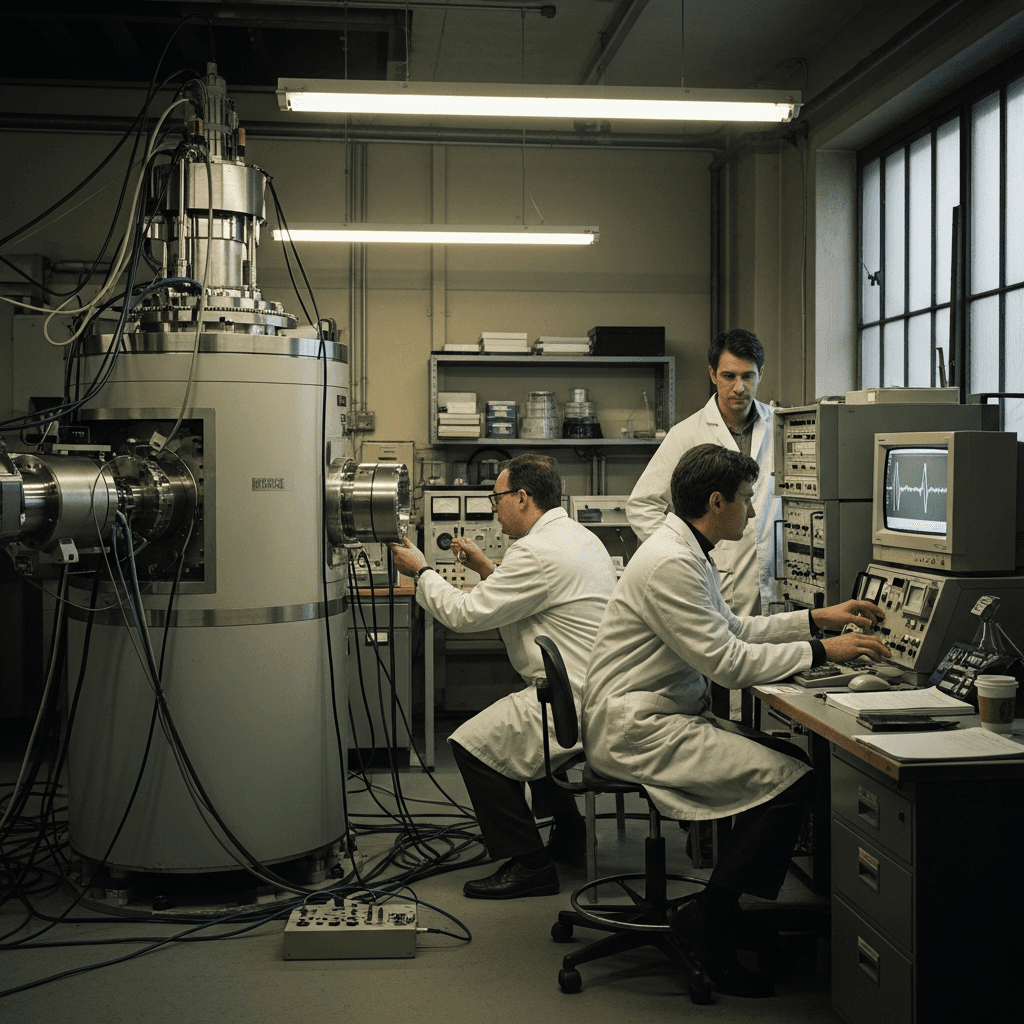
The breakthrough didn't happen in a massive cryogenic freezer or a vacuum chamber, but inside a Nuclear Magnetic Resonance (NMR) spectrometer—a machine similar to an MRI used in hospitals. Researchers Isaac Chuang, Neil Gershenfeld, and Mark Kubinec leveraged the nuclear spins of atoms within molecules in a liquid state to act as the world’s first qubits.
Specifically, they used a solution of chloroform molecules ($CHCl_3$). By treating the spin of the carbon-13 nucleus and the hydrogen nucleus as two distinct qubits, they were able to manipulate them using radio-frequency pulses. This was the first time scientists had a reliable way to initialize, gate, and read out a quantum system.
The First Quantum Algorithm
The milestone achieved in 1998 was the implementation of the Deutsch-Jozsa algorithm. While the algorithm itself solves a somewhat abstract mathematical problem—determining if a function is 'constant' or 'balanced'—it was the perfect litmus test for quantum supremacy on a small scale. Using their 2-qubit NMR setup, the team proved that a quantum computer could solve the problem in a single query, whereas a classical computer would require two.
Shortly thereafter, Chuang’s team at IBM Almaden and researchers at Oxford University successfully demonstrated Grover’s search algorithm. These weren't just simulations; they were physical proofs that quantum entanglement and superposition could be harnessed to perform computation.
Why NMR Mattered
While we now know that liquid-state NMR isn't scalable to the thousands or millions of qubits needed for a universal quantum computer (due to the signal-to-noise ratio dropping exponentially with each added qubit), its contribution to the field was foundational. It provided:
- Proof of Concept: It silenced skeptics who believed decoherence would make physical quantum computation impossible.
- Control Techniques: Many of the pulse sequences and error-correction concepts developed for NMR are still used in today's superconducting and trapped-ion systems.
- Algorithm Validation: It allowed researchers to witness quantum interference in action for the first time.
A Legacy of Innovation
Looking back from an era where companies like IBM, Google, and IonQ are racing toward hundreds of qubits, the 2-qubit breakthrough of 1998 remains a towering achievement. It was the moment the scientific community realized that the 'quantum' in quantum computing wasn't just a prefix—it was a functional, controllable reality. The 1998 NMR experiments took the field out of the realm of science fiction and placed it firmly on the roadmap of modern technology.


